Socialists look to future after edging Liberals in SA election

The South Australian Socialists have recorded 6.5% of the vote in Labor-held Croydon.
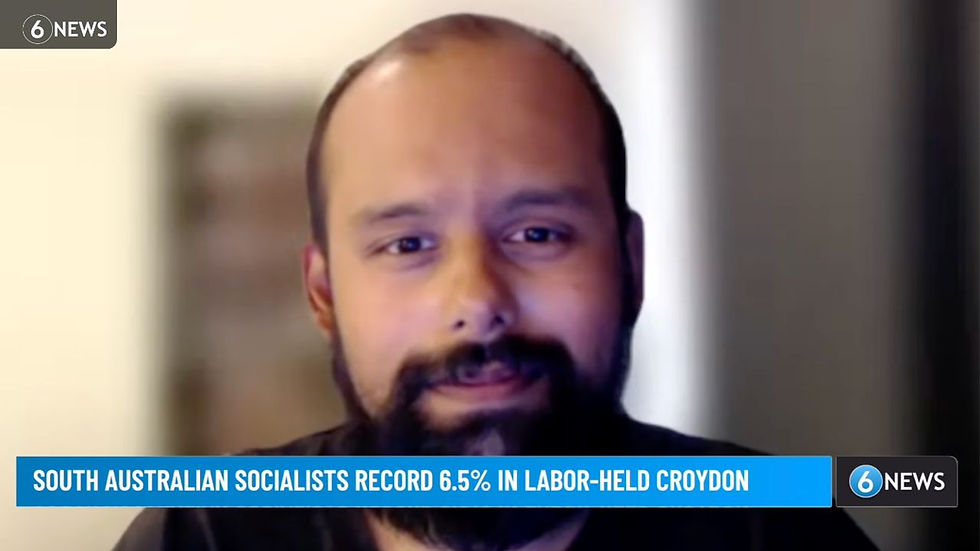
SA Socialists candidate Ahmed Azhar says his party is looking towards the future after receiving 6.5% of the vote in Peter Malinauskas's seat of Croydon – rivalling the Liberals during early stages of the vote count.
As of the latest results, the Liberals have received 7.7% of the vote, while Azhar has 6.2%. He ran as an Independent Socialist and was endorsed by the South Australian Socialists, who were formed as part of the Australia-wide expansion of the Victorian Socialists. This was the first state election campaign for the Socialist Party outside of Victoria.
“There is definitely an audience of people who are receptive to socialist politics,” Azhar told 6 News' Leo Puglisi.
“Thousands of people across the two electorates that we’ve been campaigning in have been left behind by the Labor Party: they have felt frustrated, and are looking for other options to actually take on the billionaires and the massive corporations.”
“It’s been fantastic over the past few weeks and months: building that campaign, getting into conversations, knocking on doors, staffing the polling booths, talking to working class people about the issues they’re facing in their life, and about socialist politics and how it can help.”
Azhar told Puglisi that, despite not being able to have the Socialist Party name on the ballot, and despite there being some confusion from voters, he was very open about being a South Australian Socialist candidate.
“We were extremely open on all of the material that we printed and: it was very clear socialist branding,” he said.
“We would have much preferred to have run openly under the socialist party ballot line.”
“It’s unfortunate that a lot of people who might have voted socialist might not have if they hadn’t seen our campaign or connected up the names.”
“But it just meant that every vote we got was on the basis of our ground campaign.”
“That people had, in one way or another, actually interacted with our campaign and seen that we are socialist candidates running in the election.”
When asked if he thought voters saw the word “socialism” as a dirty word, Azhar told Puglisi that his socialist beliefs were “not as much of an issue as you might imagine it to be”.
“There is a minority of people who see the word socialist and immediately think of authoritarianism, police states, and inflation and recoil to that,” Azhar said.
“But I think more and more people are actually open to [socialism].”
“The challenge was more so the fact that we’re a political party and people are cynical about politics and politicians.”
“It was ‘Are you just like another political party?’ and ‘Why would I believe that you’re any different to all of the other political parties that have run in the past?’”
“It was really cutting through that sort of cynicism, which was more of a challenge for us, than anything to do with the word “socialist”, really.”
The next South Australian state election is in 2030, but Azhar told 6 News that “elections are just one part of what we’re doing more broadly, and potentially not even the most important aspect for us”.
“We’re really thinking that social change comes from the movements that are on the streets and are built in workplaces,” he said.
“So the immediate priority for us at the moment, is building a fight against [Pauline] Hanson and the rise of One Nation.”
“That’s the other story from the election: the real breakthrough results for Pauline Hanson and One Nation, and the rise of racism.”
“Through the South Australian Socialists, we’ll build something to say that the kind of politics Pauline Hanson represents is not legitimate: it’s open racism and has to be totally challenged.”
“Right now, it’s being absolutely normalised by Peter Melinauskas: he made two phone calls – one to [South Australian Liberal Party Leader] Ashton Hurn, and one to One Nation – and then all of the coverage that they’ve got in the media.”
“There certainly is a section of the rich and powerful in society right now that have thrown their lot behind Pauline, and that’s what we’re focusing on at the moment: building that [resistance] up.”
One in five South Australians voted for One Nation in the state election.
One Nation are also in contention for up to four South Australian lower house seats, and have been confirmed to have won three upper house seats.
Multiple nationwide polls have shown an increase in One Nation voting favourability among low income earners and self-described working class people.
When asked why he thinks this demographic would vote for One Nation, Azhar said it’s a combination of far -ight politics trending around the world and uncertainty caused by the collapse of the Liberal Party.
“From the United States to Europe and India, I think [far right politics] has put a lot of wind in the sails of people like Pauline Hansen and One Nation,” he said.
“I think the main dynamic is a radicalisation of the existing right; it’s really the collapse of the Liberal Party, and a lot of former Liberal voters who are now moving over and putting their vote in for One Nation.”
“It’s a real concern, because that could grow, and more working class people could actually be won over to that politics.”
“But I think it’s important to say that the existing right of society that’s been radicalised has overwhelmingly voted on the basis of racism, not on economic grievance."
“That being said, I think it’s important to the Socialist Party to come out and say that, yes, life is getting more difficult: living standards aren’t going forward.”
“The Socialist Party puts ourselves forward as an anti-establishment voice, as an alternative to One Nation: to say that you shouldn’t be blaming your migrant neighbours down the road, you should be blaming the billionaires and the corporations who are profiting from the cost of living and the housing crisis.”
Azhar told Leo that, though elections may not be the main priority for his party, the South Australian Socialists are "definitely considering" running for the council elections.
“Keep an eye open for that one.”
The Labor Party’s Peter Malinauskas was re-elected in the seat of Croydon, with a 55.7% vote. 11,829 votes behind Labor is One Nation’s Dale Blackeby, coming in second.
The Greens’ Ruby Dolling received third place preference at an 11.4% vote, ahead of the Liberal Party’s Michael Santagata 7.7% vote by 749 votes.